
Water treatment and softeners in Chester County, PA
Willow Springs Water Company serves homes across Chester County. Public water here comes from several suppliers, some using chloramine and some reporting PFAS. On private wells, acidic, corrosive water is the most common problem: 83.3% of Chester County samples in Penn State's lab summary failed the corrosivity index. We test your water for free, then treat it.
Not sure what you need? Get your free water report in seconds →
Chester County water suppliers
The largest systems by people served (EPA), with highlights from each supplier's 2025 water quality report where we checked it. Your water bill names your supplier.
| Supplier | People served | What the 2025 report shows |
|---|---|---|
| Aqua Pennsylvania, West Chester | 48,600 | Brandywine Creek and two wells. Chlorine. Nitrate about 4 ppm. PFOA up to 5.9 ppt; PFOS not detected. Hardness not listed. |
| Aqua Pennsylvania, Uwchlan | 35,518 | PFOA up to 10 ppt and PFOS up to 6.2 ppt (state limits 14 and 18). Nitrate up to 4.7 ppm. |
| Pennsylvania American Water, Coatesville | 36,960 | Rock Run Reservoir and West Branch Brandywine Creek. Chloramine. Hardness 73 mg/L average (42 to 102). |
| Chester Water Authority (southern Chester County) | — | Octoraro Reservoir and Susquehanna River. Chloramine. Hardness 90 to 150 mg/L. Nitrate up to 7 ppm. |
| Pennsylvania American Water, Royersford | 49,508 | Report not reviewed here. |
| Phoenixville Water Dept.; Downingtown Water Authority; Kennett Square | 16,599; 9,900; 6,328 | Reports not reviewed here. |
Where a report doesn't list hardness, our free in-home test measures it.
Chester County well water
Penn State's Agricultural Analytical Services Lab summarizes the samples Chester County homeowners send in.
| Chester County well samples (Penn State lab, 2008 to 2025) | Failed the standard |
|---|---|
| Corrosivity index | 83.3% |
| Total coliform bacteria | 29.3% |
| pH (median 6.9) | 29.2% |
| Manganese | 14.8% |
| Iron | 14.6% |
| First-draw lead | 9.2% |
| Nitrate | 5.2% |
| E. coli | 2.2% |
490 samples, 1/18/2008 to 6/9/2025. Median hardness 81.8 mg/L. Not a random survey.
What we treat most
Acidic water. Blue-green stains, pinhole leaks and lead risk. Acidic water →
Bacteria. Needs a lab test; treated with UV. Bacteria in well water →
Iron and manganese. Orange and black stains →
PFAS and chloramine on public water. Whole-house filter prices →
New well? Chester County Health Department requires a permit before drilling and a certified lab test of the new well before approval.
Water treatment services in Chester County
Whole-house filter cost
Carbon + tankless RO from $2,895.
Water Softeners
Sized to your hardness.
Reverse Osmosis
Reduces PFAS, lead and nitrate at the kitchen sink.
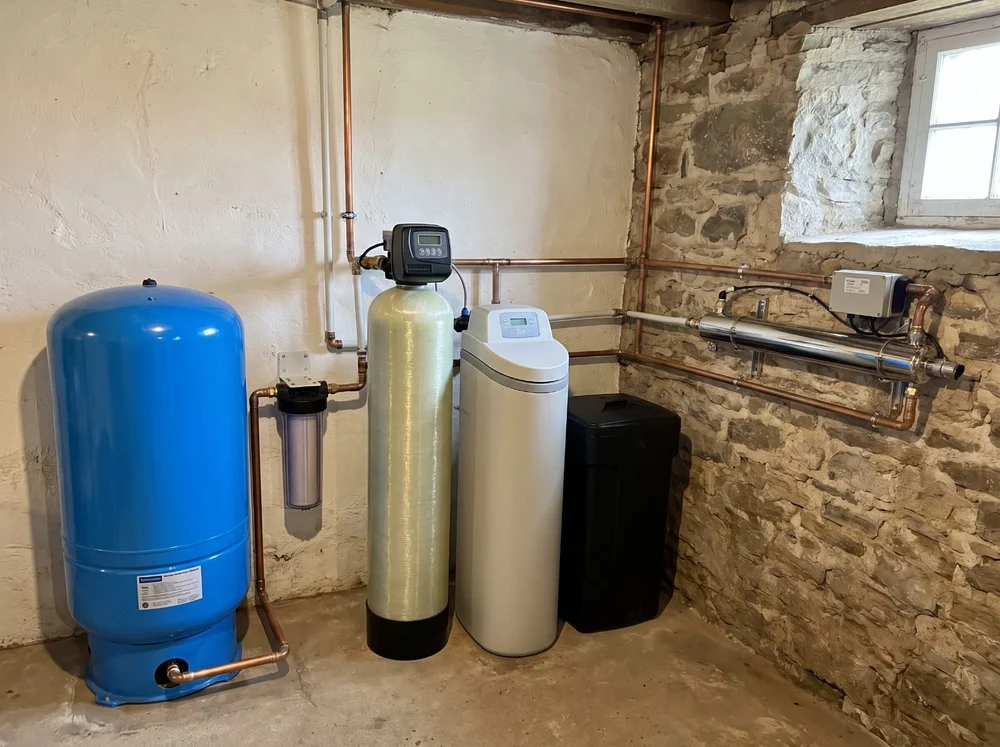
Well Water Treatment
Acidic water, bacteria, iron and manganese.
Well water treatment cost
Installed prices for every piece.
Free Water Testing
We test at your sink and explain the results.
How it works
Request your instant free quote
Fill out the free quote form or call (610) 400-3132. Tell us your address and whether you're on city water or a well.
We quote you on the spot
You get a clear price for your system right then, starting from a base package at a set price.
A free water test confirms your setup
Before we install, we test your actual water for free so you only pay for the treatment your water needs.
We install your system
We install it cleanly, show you how it works, and let you know when filters and service are due.
Chester County water: common questions
Is Chester County water hard?
It depends on the supplier. Chester Water Authority reports 90 to 150 mg/L (5 to 9 grains per gallon), moderately hard to hard. Pennsylvania American Water's Coatesville system averaged 73 mg/L. The median private-well sample in Penn State's Chester County lab summary was 81.8 mg/L.
Is there PFAS in Chester County water?
Some systems report it. Aqua Pennsylvania's 2025 Uwchlan report shows PFOA up to 10 parts per trillion and PFOS up to 6.2, and its West Chester report shows PFOA up to 5.9. Pennsylvania's limits are 14 for PFOA and 18 for PFOS. Reverse osmosis at the kitchen sink reduces PFAS in drinking water.
Do Chester County wells need to be tested?
Chester County Health Department requires a permit to drill a new well and requires new wells to be tested by a state-certified lab for bacteria, nitrate, pH, iron, manganese, arsenic and other items. Beyond that, Penn State recommends testing for bacteria every year.
What problems do Chester County wells have?
In Penn State's lab summary of 490 Chester County samples, 83.3% failed the corrosivity index, 29.3% failed for total coliform, 29.2% for pH, 14.8% for manganese and 14.6% for iron. Acidic, corrosive water is the most common issue.
Do you serve Chester County?
Yes. We serve homes across Chester County on public water and private wells. Call (610) 400-3132.
Written by Sam Beiler, co-founder of Willow Springs Water Company, Sinking Spring, PA. Last updated October 2026.
- U.S. EPA ECHO, community water systems in Chester County
- Aqua Pennsylvania, 2025 Water Quality Report, West Chester (PA1150098)
- Aqua Pennsylvania, 2025 Water Quality Report, Uwchlan (PA1150035)
- Pennsylvania American Water, 2025 Water Quality Report, Coatesville
- Chester Water Authority, 2025 Water Quality Report
- Penn State Agricultural Analytical Services Lab, Chester County drinking water test summary
- Chester County Health Department Rules and Regulations, Chapter 500, Section 501 (Wells)
- Chester County Health Department, Conditions for Well Approval
- Penn State Extension, Testing Your Drinking Water