
Buying a home with a well in Pennsylvania: what to test
Pennsylvania doesn't require a well test when a house is sold, but Penn State Extension recommends testing before you buy. It matters: in Penn State's county lab summaries, about 40% of Berks and Lancaster County samples failed for coliform bacteria. Here's what to test, when, and what fixes cost if something comes back high.
Not sure what you need? Get your free water report in seconds →
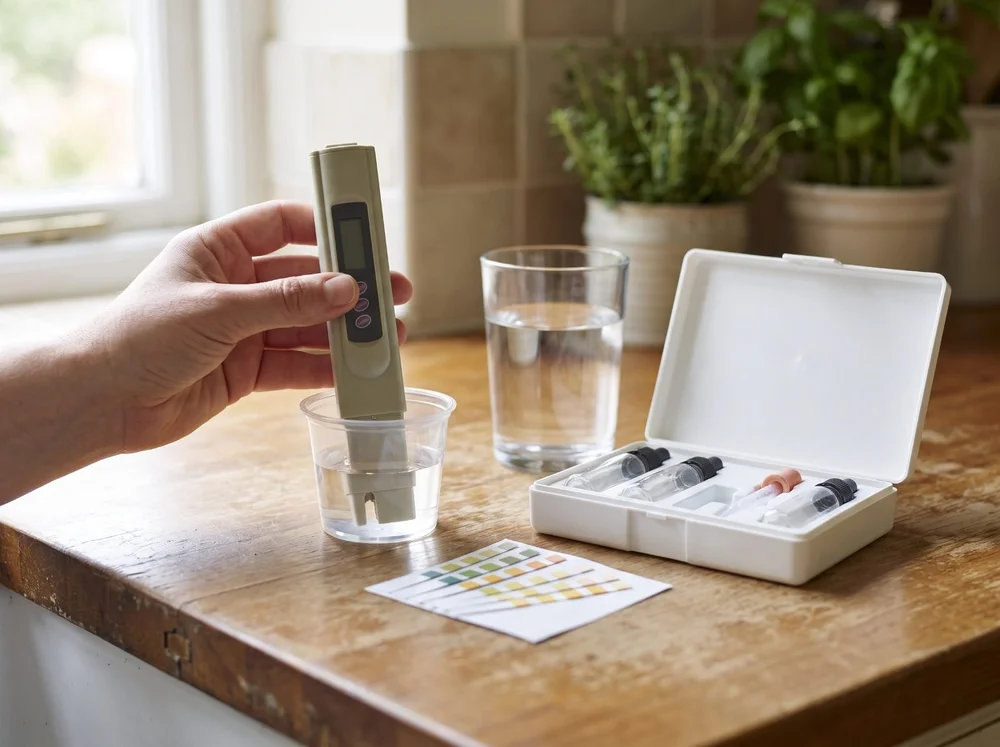
What to test before you buy
Use a lab certified by the Pennsylvania DEP and have a neutral party collect the sample.
| Test | Why | Priority |
|---|---|---|
| Total coliform and E. coli bacteria | Shows whether surface water or waste is reaching the well | Always |
| Nitrate | Common near farms and septic systems; limit 10 mg/L | Always |
| pH and corrosivity | Acidic water corrodes pipes and can release lead and copper | Always |
| Total dissolved solids | Overall mineral load; Penn State suggests every three years | Always |
| Lead (first-draw) | Comes from plumbing, not the well; worse with acidic water | Recommended |
| Iron and manganese | Orange, brown or black stains and metallic taste | Recommended |
| Hardness | Scale and spots; decides whether you need a softener | Recommended |
| Pesticides, VOCs | Near farm fields, gas stations or industrial sites | If nearby |
How often local wells fail
| Penn State lab samples, 2007 to 2025 | Berks | Lancaster | Chester |
|---|---|---|---|
| Total coliform | 40.2% | 41.5% | 29.3% |
| E. coli | 7.8% | 10.3% | 2.2% |
| Corrosivity index | 76.8% | 68.4% | 83.3% |
| Nitrate | 7.5% | 24.8% | 5.2% |
| First-draw lead | 8.2% | 12.1% | 9.2% |
Share of samples failing each standard. These are samples homeowners chose to send in, not random surveys.
Timeline tips
Test during the inspection period. Lab results usually take several days to come back, so order the test as soon as your offer is accepted.
Ask about the well itself. Age, depth, cap condition and any past test results. Penn State notes Pennsylvania has no statewide well construction standards.
Check your loan. Some FHA loans require a water test; ask your lender which tests and how recent.
Chester County new wells. Chester County Health Department requires a permit and a certified lab test for newly drilled wells.
If something fails
Most well water problems are fixable, and the cost is known up front. Installed prices from Willow Springs:
| Problem | Fix | Price |
|---|---|---|
| Bacteria | UV disinfection | $1,395 |
| Acidic water | Acid neutralizer | $2,295 |
| Iron | Iron filter | $2,895 |
| Hardness | Water softener | $2,295 |
| Nitrate, lead (drinking water) | Tankless RO | $1,195 |
How Willow Springs helps buyers and new owners
We test hardness, iron, pH and TDS free at the kitchen sink, explain any lab report you already have, and give you a written price for whatever treatment the water needs.
Buying a home with a well: common questions
Does Pennsylvania require a well test when a house is sold?
No. Penn State Extension says there are no state regulations requiring private well owners to test their water, and testing at sale isn't required by the state. It is still typically done, and Penn State recommends testing before you buy.
What should I test for when buying a home with a well?
At minimum, total coliform and E. coli bacteria, nitrate, pH and total dissolved solids. Add lead, iron, manganese and hardness, and test for pesticides near farm fields. Use a lab certified by the Pennsylvania DEP.
Does my mortgage require a water test?
Some loans do. FHA rules can require a well water test in certain cases, such as near farms or landfills or when the appraiser notes a problem. Ask your lender early so the test fits your closing timeline.
Who should take the sample?
A neutral third party, ideally the lab or an inspector, following the lab's instructions. Some loans require it. Running the water for a while or using a treated tap can hide problems.
What if the test fails?
Most problems are fixable. Bacteria is usually handled by fixing the well cap or casing, shock chlorination and, if it returns, UV disinfection ($1,395 installed). Acidic water takes a neutralizer ($2,295), iron a filter ($2,895). Many buyers negotiate the cost into the sale.
How often should I test after I move in?
Penn State recommends testing for coliform bacteria every year and for pH and total dissolved solids every three years, plus after any change in taste, smell or color.
Written by Sam Beiler, co-founder of Willow Springs Water Company, Sinking Spring, PA. Last updated October 2026.
- Penn State Extension, Best Management Practices for Private Water Wells
- Penn State Extension, Testing Your Drinking Water
- Penn State Extension, Private Water Systems FAQs
- Pennsylvania Association of Realtors, Private water sources: what buyers should consider
- Penn State Agricultural Analytical Services Lab, Berks County drinking water test summary
- Penn State Agricultural Analytical Services Lab, Lancaster County drinking water test summary
- Penn State Agricultural Analytical Services Lab, Chester County drinking water test summary
- Chester County Health Department Rules and Regulations, Chapter 500, Section 501 (Wells)
- Penn State Extension, Coliform Bacteria