
Water softener vs salt-free conditioner
A water softener removes the calcium and magnesium that make water hard. A salt-free conditioner leaves them in and tries to keep them from forming scale. That difference decides whether you get soft water, spot-free dishes and lather, or just less scale. Here's an honest side-by-side.
Not sure what you need? Get your free water report in seconds →
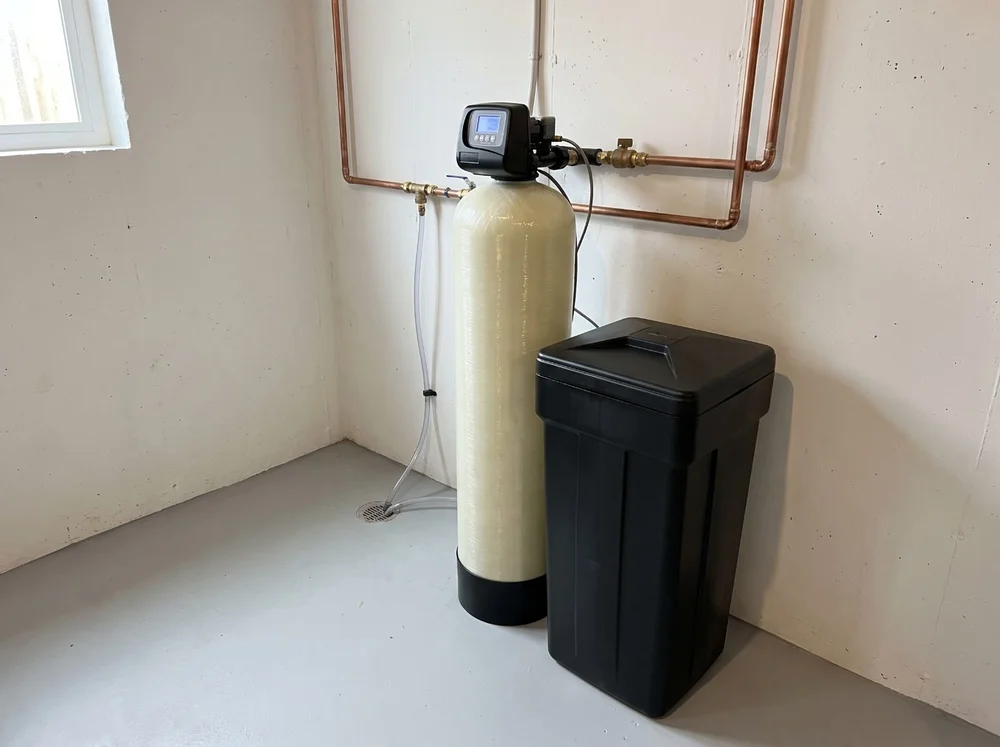
How they compare
| Salt-based softener | Salt-free conditioner (TAC) | |
|---|---|---|
| How it works | Ion exchange: resin swaps calcium and magnesium for sodium or potassium | Converts dissolved hardness into tiny crystals; minerals stay in the water |
| Removes hardness? | Yes | No |
| Spots, soap film, lather | Eliminated | Little or no change |
| Scale in water heater and pipes | Prevented | Reduced, by design claims |
| Salt | Yes, refilled monthly or so | None |
| Water for regeneration | About 50 gallons per cycle (Penn State) | None |
| Sodium added | 7.5 mg per quart per grain removed (Penn State) | None |
| Certification | NSF/ANSI 44 | IAPMO Z601 / DVGW W512 for scale reduction |
| Evidence | Long-established | Nebraska Extension: few conclusive studies for residential use |
What the experts say
Salt-free systems don't remove hardness. Nebraska Extension says salt-free technologies "do not remove most of the hardness-causing minerals."
Evidence is limited. Nebraska Extension: few conclusive studies confirm these devices work in homes.
Magnetic devices are unproven. Nebraska Extension calls magnetic treatment an unproven technology without a strong scientific basis.
Ask for testing. IAPMO Z601 requires an 80% scale reduction under its test. A Water Quality Association article noted results under one use pattern may not match yours.
Which is right for you?
Choose a softener if you want soft water: no spots, better lather, no scale. Most homes on very hard water fall here. How to choose →
Consider salt-free if you only want less scale, can't discharge brine, or your water is under about 7 grains per gallon.
Maybe neither if your water is soft. Our City Clean package filters chlorine and adds reverse osmosis drinking water with no softener, $2,895.
Softener prices, installed
| System | Price, installed | With financing* |
|---|---|---|
| Water softener | $2,295 | about $49/mo |
| Water softener, upgraded control valve | $2,695 | about $57/mo |
| City Clean: carbon filter + tankless RO (no softener) | $2,895 | about $61/mo |
| City Essential: carbon + softener combo tank + tankless RO | $3,295 | about $70/mo |
| City Premium: carbon filter + softener + tankless RO | $4,495 | about $95/mo |
*60 months at 9.99% APR, subject to credit approval. Prices installed, as of October 2026.
How it works
Request your instant free quote
Fill out the free quote form or call (610) 400-3132. Tell us your address and whether you're on city water or a well.
We quote you on the spot
You get a clear price for your system right then, starting from a base package at a set price.
A free water test confirms your setup
Before we install, we test your actual water for free so you only pay for the treatment your water needs.
We install your system
We install it cleanly, show you how it works, and let you know when filters and service are due.
Softener vs salt-free: common questions
Do salt-free water softeners remove hardness?
No. Nebraska Extension says salt-free technologies don't remove most of the hardness minerals. Template-assisted crystallization (TAC) systems convert dissolved hardness into tiny crystals meant to resist forming scale, but the calcium and magnesium are still in the water.
Will a salt-free conditioner stop spots on dishes?
Generally not. Spots and soap film come from the hardness minerals, which a salt-free conditioner leaves in the water. Its claim is reduced scale buildup, not soft water.
Do magnetic or electronic water conditioners work?
Nebraska Extension calls magnetic water treatment an unproven technology without a strong scientific basis, and says there's no scientific consensus that it works.
Is there a certification for salt-free conditioners?
Softeners are certified to NSF/ANSI 44. For scale-control devices, IAPMO Z601, based on the German DVGW W512 test, requires an 80% reduction in scale. Ask for the certification and the test conditions.
When does a salt-free conditioner make sense?
When you only want to reduce scale, can't discharge brine, or your water is only slightly hard. Penn State Extension says water below 7 grains per gallon probably won't cause major scaling.
Which do you install?
Salt-based softeners, because they actually remove hardness. If your water is soft enough not to need one, we'll tell you; our City Clean package filters city water without softening for $2,895.
Written by Sam Beiler, co-founder of Willow Springs Water Company, Sinking Spring, PA. Last updated October 2026.
- Nebraska Extension, Drinking Water Treatment: Salt-Free Water "Softener" Options (G2275)
- Nebraska Extension, Hard Water (Calcium and Magnesium) (G1274)
- Penn State Extension, Water Softening
- NSF, Standards for Water Treatment Systems
- Water Conditioning & Purification, New Standard for Evaluation of Scale Control Equipment (2014)
- WaterWorld, Water Quality Association: Sorting Out Scale Prevention (2012)