
Black stains from well water? It's usually manganese
Black or dark brown stains in toilets, sinks, dishwashers and laundry are the classic sign of manganese in well water. Penn State Extension says the water can look clear from the tap and still leave black stains once it meets air. Here's how much is too much, how common it is around here and what removes it.
Not sure what you need? Get your free water report in seconds →
How much manganese is too much?
EPA has two reference levels for manganese. Neither is enforceable for private wells, which Pennsylvania doesn't regulate.
| Level | What it is | Why |
|---|---|---|
| 0.05 mg/L | EPA secondary standard | Black-brown color, black staining, bitter metallic taste |
| 0.3 mg/L | EPA lifetime health advisory | Possible neurological effects from regular drinking over time |
| 0.3 mg/L for infants | EPA advice for babies under 6 months | Applies even to short exposures; infants may absorb more manganese |
| 1 mg/L | EPA 1-day and 10-day health advisory | Short-term exposure for children and adults |
How often local wells test high
Share of samples above 0.05 mg/L in Penn State's lab summaries, 2007 to 2025.
| County | Samples | Above 0.05 mg/L | Highest result |
|---|---|---|---|
| Berks | 179 | 13.4% | 9.49 mg/L |
| Lancaster | 109 | 14.7% | 2.93 mg/L |
| Chester | 229 | 14.8% | 10.40 mg/L |
These are samples homeowners chose to send to Penn State's lab, not a random survey. The median sample in all three counties was 0.01 mg/L, so most wells are fine and a few are very high.
Signs of manganese
Black or brown-black stains in toilet bowls, sinks, tubs and the dishwasher.
Gray or dingy laundry, especially whites, and dark spots after bleach.
Black specks or particles that show up after the water sits.
A bitter, metallic taste in drinking water, coffee and tea.
Orange stains too? Iron and manganese often show up together. See orange or brown stains →
What removes it
Penn State Extension describes several options, and which one works depends on how much manganese you have, your pH and whether iron is present.
| Method | Notes |
|---|---|
| Softener | Only small amounts; oxidized manganese fouls the resin |
| Oxidizing filter (greensand, birm or similar) | Greensand suits combined iron and manganese of about 3 to 10 mg/L; birm needs pH 7.5 or higher for manganese |
| Oxidation + filtration | Most effective when combined iron and manganese are above 10 mg/L |
| Polyphosphate | Generally ineffective for manganese |
What manganese treatment costs
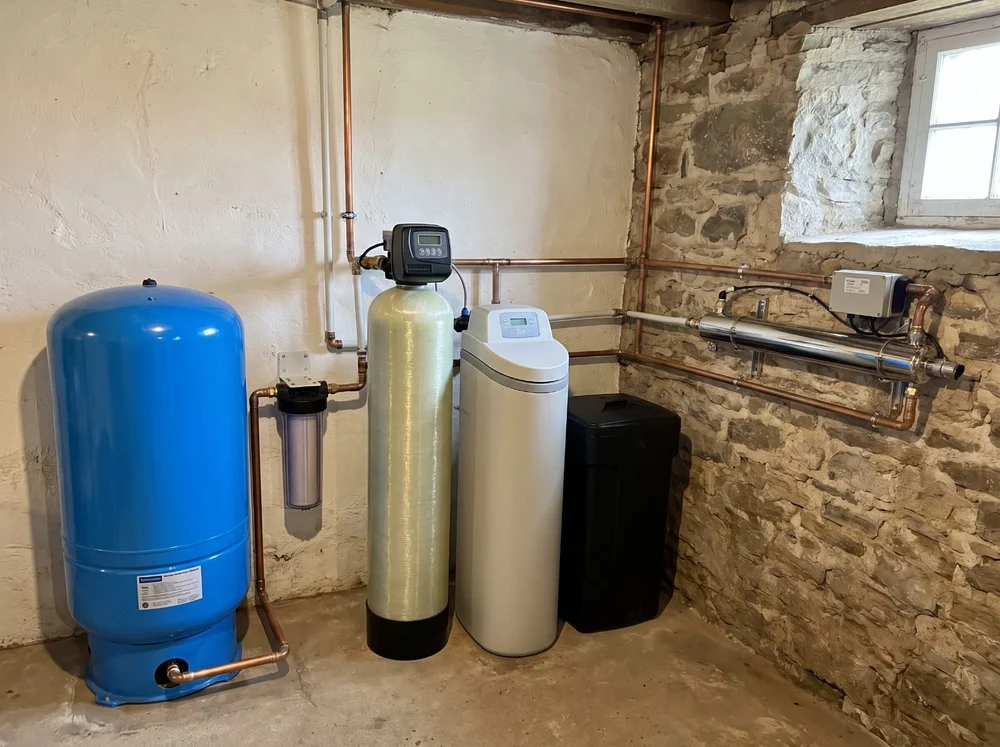
Manganese is treated with the same kind of equipment as iron, sized and set up from your test results.
| System | Price, installed | With financing* |
|---|---|---|
| Iron and manganese filter | $2,895 | about $61/mo |
| Iron and manganese filter + water softener | $5,190 | about $110/mo |
| Iron and manganese filter + UV disinfection | $4,290 | about $91/mo |
| Iron and manganese filter + softener + UV disinfection | $6,585 | about $140/mo |
*60 months at 9.99% APR, subject to credit approval. Prices installed, as of October 2026.
We test manganese free at your sink, along with iron, hardness and pH. If your levels call for a different method, we tell you before quoting. All well water prices →
How it works
Request your instant free quote
Fill out the free quote form or call (610) 400-3132. Tell us your address and whether you're on city water or a well.
We quote you on the spot
You get a clear price for your system right then, starting from a base package at a set price.
A free water test confirms your setup
Before we install, we test your actual water for free so you only pay for the treatment your water needs.
We install your system
We install it cleanly, show you how it works, and let you know when filters and service are due.
Manganese and black stains: common questions
What causes black stains in my sink and toilet?
Usually manganese. Penn State Extension says well water with manganese can look clear at first, then leaves black stains or particles once it's exposed to air. Manganese often makes a dense black stain. Black slime can also come from manganese-feeding bacteria, which a water test can help sort out.
How much manganese is too much?
EPA's secondary standard is 0.05 mg/L, set for staining and taste. EPA's lifetime health advisory is 0.3 mg/L, set because of possible neurological effects from drinking water above that level over time.
Is manganese a concern for babies?
EPA advises that for infants younger than 6 months, the 0.3 mg/L lifetime advisory be used even for short exposures of 10 days, because infants may absorb more and excrete less manganese. If your well tests above 0.3 mg/L, talk to your pediatrician about water for infant formula.
How common is manganese in local wells?
In Penn State's lab summaries, 13.4% of Berks County samples, 14.7% of Lancaster County samples and 14.8% of Chester County samples were above 0.05 mg/L. Those are samples homeowners chose to send in, not a random survey.
Will a water softener remove manganese?
Only small amounts, and only in the right conditions. Penn State Extension says softeners are sometimes effective for small amounts of manganese, and that oxidized manganese fouls softener resin.
What removes manganese?
An oxidizing filter for moderate levels, or oxidation followed by filtration for high levels. Penn State Extension notes that birm filters need a pH of at least 7.5 for manganese and that polyphosphate is generally ineffective for it. Your test results decide the right method.
What does manganese treatment cost?
Manganese is treated with the same kind of equipment as iron. Our iron filter is $2,895 installed, about $61 a month with approved financing. With a softener it's $5,190. Your free water test confirms the setup and price before we install.
Written by Sam Beiler, co-founder of Willow Springs Water Company, Sinking Spring, PA. Last updated October 2026.
- Penn State Extension, Iron and Manganese in Private Water Systems
- U.S. EPA, Secondary Drinking Water Standards
- U.S. EPA, Drinking Water Health Advisory for Manganese (EPA-822-R-04-003)
- Penn State Agricultural Analytical Services Lab, Berks County drinking water test summary
- Penn State Agricultural Analytical Services Lab, Lancaster County drinking water test summary
- Penn State Agricultural Analytical Services Lab, Chester County drinking water test summary